

The question I kept asking myself throughout the book: Why did the author feel compelled to create a narrative about an image so ubiquitous it's almost a cliché? Ok, maybe not entirely a cliché, but this painting is known as "The Mona Lisa of the North" and "The Dutch Mona Lisa." Obviously, the painting is well-known for a reason. It is beautiful.
I wonder what the compulsion is...to make things more interesting than they really are. Or, is that just the art of being a storyteller? We all do it. I guess I just wonder why in this case she felt the need to impose an unlikely story on the painting, rather than just letting the painting stand on its own. I suppose in a way the "what if" speculation of the book is kind of fun, but I also wonder if it affects the way so many people look at the painting after reading the book? The main reason the story even works is that we don't actually know much about the painting or the artist.
Characters: At first, I got tired of everyone tip-toeing around Catharina. Then I got thinking...the entire book is written in first person from Griet's point of view. Of course a mostly ignorant 16-year old would have a negative perspective on the crazy pregnant lady, right? It's a very teenage point of view and you can kind of see how her perspective is limited by her experience and the way she was brought up. Once I thought of it that way, and once I read that Catharina had ELEVEN children by the end, I actually felt a lot more sympathetic toward her. The book makes Vermeer's family seem pretty dysfunctional at least from a 21st century perspective, but who really knows? I had a hard time with Vermeer's character (Even though in the book everything about his character was Griet's perception of his character, so we don't really know exactly what he was like). I thought he appeared weak and easily manipulated and I don't really like thinking of one of my favorite artists in that way. Then again, at that time artists were pretty much at the beck and call of their patrons, so in a way he didn't really have a choice but to paint Griet, even if he didn't want to, at least in this story. Griet's character was also problematic for me. Although incredibly awkward, she was too perfect from her own perspective (I guess that's what you get with a first-person narrative). Her laundry was always the cleanest and whitest and she always knew how to pick the best cuts of meat and she mulls paint pigments to perfection and (here's what really gets me) she even knew better than Vermeer what his paintings needed. No way am I going to buy that. No way.
Things I liked about the book: I liked the pace. There was something intriguing about even the most mundane tasks that Griet has to do around the household. The language used by Chevalier is beautiful and appeals to the senses. There is something simple about the way she writes and yet there is so much going on below the surface (much like the characters in the book). I actually listened to an interview with Tracy Chevalier through the BBC World Book Club and she mentioned that she used simplicity in her writing to attempt to emulate the restrained style of Vermeer's paintings. I also liked how there was just enough tension and strangeness to the book that it kept the story intriguing. I also appreciated the fact that Chevalier didn't take the easy route and automatically make Griet Vermeer's mistress. Thank goodness.
Things we do actually know for sure: Vermeer did paint Girl with a Pearl Earring circa 1665-1666. It is currently in the Mauritshuis in The Hague. He did use a camera obscura, which is an optical device that helped him in composing his paintings and creating areas of focus. Vermeer was in debt several times during his career and died due to some stress related illness around age 43. The names of his family members are all accurate (Maria Thins, Catharina, and his children). It is also documented that they had a servant named Tanneke. Van Leeuwenhoek and van Ruijven are also real people. We don't know for sure that van Ruijven and Vermeer knew each other, although van Ruijven, a wealthy Delft burgher, ended up with 20+ of Vermeer's 35-ish paintings, so it is possible he was a patron. Griet's character is entirely fictional. Aaaand, that's about it.
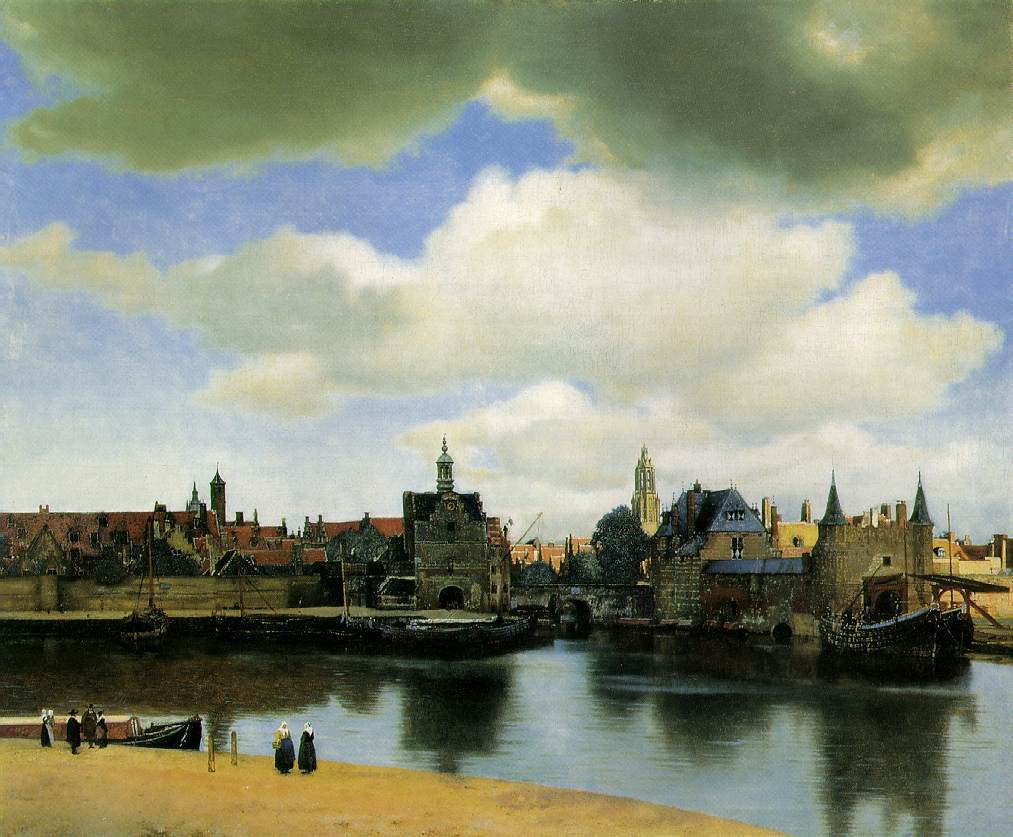
Vermeer is one of my favorite artists. I think his paintings are dignified and have a poetic and timeless quality to them. He understood the important psychological impact of perspective, light, and color for creating mood and meaning. What I now want to know is how he painted such quiet, tranquil scenes when he had 11 children running around the house?!
So, can we all meet in Delft at the end of October for book club??
Some related books I have wanted to read: The Forger's Spell: A True Story of Vermeer, Nazis, and the Greatest Art Hoax of the Twentieth Century or The Man Who Made Vermeers: Unvarnishing the Legend of Master Forger Han van Meegeren


No comments:
Post a Comment