Every single time I buy hummus, I always think to myself, "Why am I buying this? It is so easy and so cheap to make!" And, then I still buy it. I think it's because once upon a time Baptiste and I tried to make hummus at home in the blender (and the first rule of at-home hummus production is: Don't use a blender. Use a food processor! The ground chick peas are just a little too thick/dense for the average blender, as we quickly learned...) and the whole thing exploded. Everywhere. We were both plastered with hummus and I was scraping hummus off the ceiling and out of the cupboards for several days after. Well, that was about 5 years ago and it has taken me that long to get over the experience! Anyway, with access to a good food processor or even a nice conversion blender, hummus and tzatziki are very easy to make. I often like to keep these two in the fridge for dipping veggies and as alternatives to mayo on sandwiches.
Turkish Hummus
Turkey, makes 2 cups
In Turkey, hummus is made without the tahini used in Middle Eastern versions. This makes for a lighter version, with garlic and lemon juice and savory with cumin.
1 c dried chick peas (garbanzo beans) rinsed and soaked in 4 cups of water for 6 hours or overnight; or 2 cups drained and rinsed canned chick peas.
4 c water (if using dried chick peas)
Salt
2-4 garlic cloves (I usually go a bit heavy-handed on the garlic, but I only used 3 cloves and it was very garlicky. Next time I might just use 2 large cloves.)
1 t ground cumin seeds
4 T extra virgin olive oil
3 T fresh lemon juice (more to taste)
3 T drained yogurt (I used about 5 T undrained regular plain yogurt)
1/2 t Aleppo pepper (I used paprika, which is not as spicy as Aleppo.)
1. If using dried chick peas, drain and combine with the water in a large saucepan or pot. Bring to a boil, reduce heat, and summer for 1 hour. Add salt to taste (about 2 t) and continue to simmer until tender, about 1 hour. Drain. (I skipped this step since I used canned chick peas.)
2. Turn on a food processor fitted with a steel blade and drop in the garlic. Process until the garlic adheres to the sides of the bowl. Turn off the machine and scrape down the sides of the bowl. Add the cooked or canned chick peas and cumin and process to a coarse paste.
3. Combine the olive oil, lemon juice, and yogurt (I used a whisk), and add to the chick peas. Process until the mixture is smooth. Season generously with salt and more lemon juice if you want. Scrape into a bowl. Drizzle with olive oil and sprinkle with the Aleppo pepper. (I used paprika.)
Keeps for 3-4 days in the refrigerator.
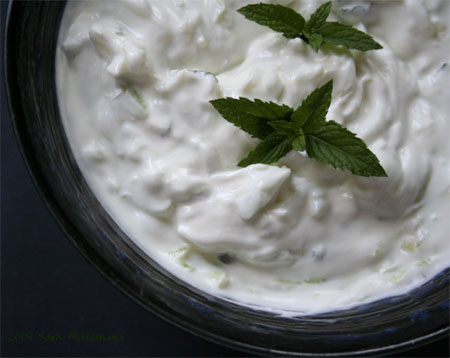
Tzatziki
Greece, serves 6
1 English cucumber, peeled and grated on the large holes of a box grater (or use a food processor)
Salt
2-3 garlic cloves (to taste) (I used 2)
2 T extra virgin olive oil
1 1/2 c drained yogurt (4 cups undrained) (I used undrained regular plain yogurt)
1-2 T chopped fresh mint or dill (I used mint)
1 T red wine vinegar
1. Sprinkle the cucumber generously with salt, toss, and place in a colander in the sink. Let sit for 30 minutes. Rinse and squeeze out water.
2. Combine the garlic cloves, 1 T olive oil, and salt in a mortar and pestle and grind to a paste.
3. Toss the cucumber with the garlic paste, yogurt, mint, vinegar, and remaining 1 T oil. Taste and adjust salt and garlic. Refrigerate until ready to serve.
Don't make this too far in advance because the cucumbers will continue to release water into the tzatziki and bright flavors will fade.
I also just discovered that the author of the cookbook I selected (Martha Rose Shulman) writes a column for the NY Times Fitness and Health section entitled Recipes for Health. It's a great column with lots of delicious-looking easy recipes. Overall, I really enjoyed reading her cookbook Mediterranean Harvest. It was full of great, basic Mediterranean recipes that are very healthy and easy enough that they don't feel overwhelming for weeknight cooking. I will definitely be coming back to this cookbook!
PS: I'm starting to mull over some ideas in my head for our next book selection. If there is a particular genre you're interested in or maybe one we haven't done yet...let me know :) I have a few options in mind, but I want to know what interests each of you in order to pick something everyone will enjoy! Do you have anything in particular at the top of your to-read list?
Showing posts with label cookbooks. Show all posts
March 22, 2010
March 18, 2010
Soupe au Pistou
This is the PERFECT soup to kick off spring. My first experience with soupe au pistou was actually last May when we were visiting some of Baptiste's cousins in Provence. When Baptiste's cousin Isabelle served it to us, I think I ate about 2 gallons of the stuff it was SO GOOD. Provençal cuisine is amazing (Provence is the region of southeastern France on the Mediterranean adjacent to Italy). It is my very favorite of all French food. I actually kind of have a hard time with a lot of traditional French food because it tends to be heavy, creamy, and meaty. Provençal food takes the best of it all and presents it with a lighter, fresh Mediterranean style.
This soup is super-duper flexible. The zucchini and tomatoes are Provençal classics, but you can add whatever vegetables you want as long as you finish the soup with the basil...that's what makes it soupe "au pistou." If you don't have turnips or potatoes or leeks on hand, just skip them. Pistou is basically the same idea as Italian pesto, except that there are no pine nuts and occasionally it includes tomatoes. The essential pistou ingredients are garlic, basil, and olive oil. This recipe offered a slightly fancier version, which included tomato and parmesan or gruyère cheese. This recipe is guaranteed to be a new favorite--Delicious!!
Soupe au Pistou
France (Provence), serves 8-10
This big spring vegetable soup from Provence is like an Italian minestrone (but in my opinion tastes SO much better!!), but the enriching comes at the end rather than at the beginning. Instead of cooking aromatics in oil before adding water and vegetables, here everything is just thrown into the pot and cooked until the vegetables are tender and the broth fragrant. Then, just before the soup is served, a rich Provençal pesto (pistou) is stirred in.
For the soup:
2 c dried white beans, picked over, rinsed, soaked in water for 6 hours or overnight, and drained. (I started cooking the soup at 5pm, so soaking dried beans wasn't really an option. I used 2 cans of great northern white beans. Lima beans would also work just fine. Dried beans have less sodium and more fiber than canned beans, but if you use canned beans you'll be able to cook the soup faster and end up adding less additional salt overall.)
8 c water
1 large onion, chopped
6-8 garlic cloves
A bouquet garni made with a few sprigs each: fresh thyme, and parsley, a Parmesan rind, and a bay leaf (I didn't have fresh thyme or a Parmesan rind (which will give the soup a more robust flavor), so I just tossed in a handful of Italian (flat leaf) parsley, a few bay leaves, and 3-4 t dried bouquet garni. I love bouquet garni and use it all the time. It's a traditional French mixture of herbs like herbes de provence that includes savory, rosemary, thyme, Turkish oregano, basil, dill weed, marjoram, sage and tarragon. When used fresh, the herbs are usually just tied together with a little string and tossed in the pot. I usually buy dried bouquet garni from Penzey's Spices, but it may even be available in the grocery store. Or, you could easily mix up the herbs yourself! If you can't get dried bouquet garni and don't have fresh thyme, just add the parsley, some dried thyme, and a couple of bay leaves. Don't forget that dried herbs and spices are stronger than fresh.)
1/2 lb. green beans, trimmed and cut into 1" pieces (optional, but I used them)
2 medium zucchini, diced (I added 3 because the zucchini were a little on the small side)
2 large carrots, peeled and chopped
2 celery stalks, chopped
2 leeks, white and light green parts only, cleaned and sliced (I did not use)
2 medium turnips, peeled and sliced (I did not use)
1 lb. red-skinned potatoes, diced (The recipe didn't indicate whether or not to peel them, so I left the skins on)
1 lb. tomatoes, peeled, seeded, and chopped; or 1 can (14 oz.) tomatoes with juice (I added 2 cans)
Salt
1/2 c soup pasta, like ditalini or capellini
Freshly ground pepper
1/2 c freshly grated Parmesan or Gruyère
For the pistou:
2-4 large garlic cloves (to taste), peeled (I think I added more like 6-7)
2 cups lightly packed fresh basil leaves, washed
Rounded teaspoon of salt (more to taste) (I think I only added about 1/2 t total)
1/3 c extra virgin olive oil
1 small tomato, peeled, seeded, and chopped (optional, I used one)
1 c freshly grated Parmesan, or a mixture of Parmesan and Gruyère (optional, I used it)
Freshly ground pepper
4. To serve, you can stir the pistou into the pot before serving, place a scoop of pistou in each bowl of soup and stir in, or pass the pistou and cheese around at the table. You can also serve it with slices of baguette or rustic Italian bread for dipping. Bon appétit!!
Note: This recipe makes a LOT of soup...which was perfect for me because I've been freezing a lot of food lately. But, for a more pared-down and probably easier, yet equally delicious version of the same recipe (but in a smaller quantity that serves about 4 people), check out this version from Mark Bittman on his NY Times blog.
This soup is super-duper flexible. The zucchini and tomatoes are Provençal classics, but you can add whatever vegetables you want as long as you finish the soup with the basil...that's what makes it soupe "au pistou." If you don't have turnips or potatoes or leeks on hand, just skip them. Pistou is basically the same idea as Italian pesto, except that there are no pine nuts and occasionally it includes tomatoes. The essential pistou ingredients are garlic, basil, and olive oil. This recipe offered a slightly fancier version, which included tomato and parmesan or gruyère cheese. This recipe is guaranteed to be a new favorite--Delicious!!
Soupe au Pistou
France (Provence), serves 8-10
This big spring vegetable soup from Provence is like an Italian minestrone (but in my opinion tastes SO much better!!), but the enriching comes at the end rather than at the beginning. Instead of cooking aromatics in oil before adding water and vegetables, here everything is just thrown into the pot and cooked until the vegetables are tender and the broth fragrant. Then, just before the soup is served, a rich Provençal pesto (pistou) is stirred in.
For the soup:
2 c dried white beans, picked over, rinsed, soaked in water for 6 hours or overnight, and drained. (I started cooking the soup at 5pm, so soaking dried beans wasn't really an option. I used 2 cans of great northern white beans. Lima beans would also work just fine. Dried beans have less sodium and more fiber than canned beans, but if you use canned beans you'll be able to cook the soup faster and end up adding less additional salt overall.)
8 c water
1 large onion, chopped
6-8 garlic cloves
A bouquet garni made with a few sprigs each: fresh thyme, and parsley, a Parmesan rind, and a bay leaf (I didn't have fresh thyme or a Parmesan rind (which will give the soup a more robust flavor), so I just tossed in a handful of Italian (flat leaf) parsley, a few bay leaves, and 3-4 t dried bouquet garni. I love bouquet garni and use it all the time. It's a traditional French mixture of herbs like herbes de provence that includes savory, rosemary, thyme, Turkish oregano, basil, dill weed, marjoram, sage and tarragon. When used fresh, the herbs are usually just tied together with a little string and tossed in the pot. I usually buy dried bouquet garni from Penzey's Spices, but it may even be available in the grocery store. Or, you could easily mix up the herbs yourself! If you can't get dried bouquet garni and don't have fresh thyme, just add the parsley, some dried thyme, and a couple of bay leaves. Don't forget that dried herbs and spices are stronger than fresh.)
1/2 lb. green beans, trimmed and cut into 1" pieces (optional, but I used them)
2 medium zucchini, diced (I added 3 because the zucchini were a little on the small side)
2 large carrots, peeled and chopped
2 celery stalks, chopped
2 leeks, white and light green parts only, cleaned and sliced (I did not use)
2 medium turnips, peeled and sliced (I did not use)
1 lb. red-skinned potatoes, diced (The recipe didn't indicate whether or not to peel them, so I left the skins on)
1 lb. tomatoes, peeled, seeded, and chopped; or 1 can (14 oz.) tomatoes with juice (I added 2 cans)
Salt
1/2 c soup pasta, like ditalini or capellini
Freshly ground pepper
1/2 c freshly grated Parmesan or Gruyère
For the pistou:
2-4 large garlic cloves (to taste), peeled (I think I added more like 6-7)
2 cups lightly packed fresh basil leaves, washed
Rounded teaspoon of salt (more to taste) (I think I only added about 1/2 t total)
1/3 c extra virgin olive oil
1 small tomato, peeled, seeded, and chopped (optional, I used one)
1 c freshly grated Parmesan, or a mixture of Parmesan and Gruyère (optional, I used it)
Freshly ground pepper
Ok, rather than write how the cookbook said to do it (because that version seemed to have all kinds of unnecessary extra steps), I'm just going to tell you what I did...
1. Put the beans, onion, carrots, celery, and potatoes in a large pot with the water, parsley sprigs and other bouquet garni spices and bay leaves. Bring to a boil and simmer, stirring occasionally, for 30-60 minutes (less if using canned beans), adding a little more water if necessary. Then add the zucchini, green beans, and tomatoes, and simmer for another 20 minutes or so.
2. Meanwhile, combine the garlic, basil, and olive oil in a food processor until pasty. Add in the chopped tomato and cheese, if using. Season with salt and pepper.
3. About 10 minutes before serving the soup add the pasta to the simmering pot and cook until al dente, about 5-10 minutes. Add pepper and adjust the salt to taste. Discard the parsley sprigs and bay leaves.
Note: This recipe makes a LOT of soup...which was perfect for me because I've been freezing a lot of food lately. But, for a more pared-down and probably easier, yet equally delicious version of the same recipe (but in a smaller quantity that serves about 4 people), check out this version from Mark Bittman on his NY Times blog.
Labels:
cookbooks
March 16, 2010
Basic Lentils
With a recipe name like "Basic Lentils" I thought I would be in for some real disappointment. Rod had requested some lentils for dinner (so grateful that he at least likes lentils even though he hates onions of all things...), I was already making some other dishes so I thought this would be a good side dish to stuff I was already cooking. It ended up being the main event--I made a few adjustments and forgot to take a picture but just take my word for it...AMAZING.
...so without futher ado...
BASIC LENTILS
1 1/2 cups brown or green lentils, sorted and rinsed (I actually ended up using 1/2 cup green lentils, 1/2 cup red lentils, 1/2 cup split peas)
1 onion, quartered
2 garlic cloves (I had 3)
2 bay leaves
1 carrot, finely diced (didn't have one so didn't use one)
1 celery rib, finely diced
1 tsp Sea Salt
fresh ground pepper
2 tblsp EVOO or butter (I used coconut oil because I love how it mixes with lentils)
Red vine vinegar to taste
Chopped parsley
Put the lentils in a soup pot (I used a dutch oven because I think the enameled cast iron just cooks so evenly and wonderful and I really think it makes a difference) , cover with 6 cups cold water (I used 4 cups of homemade chicken stock I had made a few days earlier and 2 cups water...this also makes a big difference) and bring to a boil. Skim off any foam that rises. Then add onion, garlic, bay leaves, carrot, celery, and 1 tsp salt. Lower the heat and simmer until tender but still a little firm---they shouldn't be mushy---about 25 mins. (Uh...yeah, this didn't happen...Landon had a meltdown and they ended up cooking for about 45 mins on super low heat...I actually liked it...thought it really brought out the flavor). Remove the onion, garlic, bay leaves, taste for salt, and season with pepper. Stir in the oil and add a few drops vinegar to bring up the flavor. Garnish with parsley and serve.
Because I added the mixture of split pea and red lentils and then let it cook for 45 mins it ended up being like a really thick stew or Dal. I poured it into a bowl, added a 1/2 cup of barley and wild rice to center of the bowls and it was like a little lentil "red beans and rice" type of dish. REALLY good. Hearty and filling, but pretty low calorie.
I have ended up cooking several lentil recipes from this book and HIGHLY recommend this book for purchase. :)
...so without futher ado...
BASIC LENTILS
1 1/2 cups brown or green lentils, sorted and rinsed (I actually ended up using 1/2 cup green lentils, 1/2 cup red lentils, 1/2 cup split peas)
1 onion, quartered
2 garlic cloves (I had 3)
2 bay leaves
1 carrot, finely diced (didn't have one so didn't use one)
1 celery rib, finely diced
1 tsp Sea Salt
fresh ground pepper
2 tblsp EVOO or butter (I used coconut oil because I love how it mixes with lentils)
Red vine vinegar to taste
Chopped parsley
Put the lentils in a soup pot (I used a dutch oven because I think the enameled cast iron just cooks so evenly and wonderful and I really think it makes a difference) , cover with 6 cups cold water (I used 4 cups of homemade chicken stock I had made a few days earlier and 2 cups water...this also makes a big difference) and bring to a boil. Skim off any foam that rises. Then add onion, garlic, bay leaves, carrot, celery, and 1 tsp salt. Lower the heat and simmer until tender but still a little firm---they shouldn't be mushy---about 25 mins. (Uh...yeah, this didn't happen...Landon had a meltdown and they ended up cooking for about 45 mins on super low heat...I actually liked it...thought it really brought out the flavor). Remove the onion, garlic, bay leaves, taste for salt, and season with pepper. Stir in the oil and add a few drops vinegar to bring up the flavor. Garnish with parsley and serve.
Because I added the mixture of split pea and red lentils and then let it cook for 45 mins it ended up being like a really thick stew or Dal. I poured it into a bowl, added a 1/2 cup of barley and wild rice to center of the bowls and it was like a little lentil "red beans and rice" type of dish. REALLY good. Hearty and filling, but pretty low calorie.
I have ended up cooking several lentil recipes from this book and HIGHLY recommend this book for purchase. :)
Labels:
cookbooks
Zucchini, Potato, and Artichoke Moussaka
I thought I'd kick off my recipe selection with one from Greece. I love moussaka. Baptiste introduced me to it while we were living in Paris. It's kind of like Greek lasagna without the noodles. Traditionally the moussaka sauce has beef or lamb, but during the fasting periods in the Greek Orthodox church, such as lent, they make the sauce without meat. This recipe has a great combination of eastern Mediterranean flavors and spices--the kitchen smelled SO good!
My cookbook actually listed two varieties of the same recipe, one with the traditional eggplant and one with zucchini and potato standing in for the eggplant. I have an on-again/off-again relationship with eggplant (it's either amazing or slimy), so I went with the zucchini/potato variety. I'll list the changes for the eggplant version, so you could try it that way if you're interested.
Zucchini, Potato, and Artichoke Moussaka
Greece and the Balkans, serves 6-8
For the casserole:
1 1/2 pounds potatoes, such as Yukon gold
Salt
1 3/4 pounds zucchini
2 medium onions, chopped
2 large garlic cloves, minced or put through a press (you know me, I used 5 cloves)
2 pounds tomatoes, peeled and chopped; or 1 can (28 oz.) tomatoes, with juice, chopped.
1 heaped tablespoon tomato paste
1/2 t sweet paprika (I added extra)
Heaped 1/4 t ground cinnamon (I added extra)
3 whole cloves (I'm pretty sure I added a couple more)
Pinch ground allspice (I added extra)
1/2 t sugar
1 bay leaf
Salt and freshly ground pepper
1/2 c chopped Italian (flat leaf) parsley
1 can (15 oz.) artichoke hearts packed in water, drained and rinsed
For the topping:
4 large eggs
1 1/4 c plain yogurt
Salt and freshly ground pepper
Sweet paprika
1/2 cup freshly grated Parmesan, kefalotyri, or kashkaval cheese (Let me know if you can find, let alone pronounce those Greek cheeses! I used Parmesan.)
1. Make the casserole. Heat the oven to 425ºF. Oil baking sheets with olive oil. Slice the potatoes lengthwise in oval slices about 1/4 inch thick. Place on the baking sheets, salt lightly, and bake for about 15 minutes, until they are just beginning to brown and can be easily pierced with a knife. (For the eggplant version, slice the eggplants lengthwise about 1/3" thick. Salt the slices generously and place in a large bowl or colander for 30-60 min. Meanwhile, heat the oven to 450ºF and oil baking sheets with olive oil. Then, rinse the eggplants and pat dry with a paper towel. Place on oiled baking sheets and brush tops with olive oil. Bake for 10-15 min. until lightly browned and cooked through. Transfer to a bowl. Turn oven down to 350ºF.)
2. Slice the zucchini in lengthwise slices about 1/3" thick. Heat 2 T olive oil in nonstick skillet over med-high heat and add the zucchini in a single layer (you'll have to do it in batches). Cook for about 3 min, until lightly browned. Flip over and cook for another 3 min. Transfer to a baking sheet lined with paper towels.
3. In the same skillet, heat the remaining 1 T olive oil over med heat and add the onions Cook, stirring, until tender, about 5 min., and add the garlic. Cook until fragrant, about 1 min. Stir in the tomatoes, tomato paste, paprika, cinnamon, cloves, allspice, sugar, bay leaf, and salt. Bring to a simmer, reduce heat to low. Cover and simmer for 30-45 min. stirring occasionally. The mixture should be thick and very fragrant. Stir in pepper and remove from the heat. Taste and adjust salt. Discard the bay leaf and cloves if you can see them. When the mixture has cooled slightly, stir in the parsley.
4. Heat oven to 350ºF. Oil a 3-qt baking or gratin dish. Make an even layer of half the potatoes (or eggplant) over the bottom. Top with half the zucchini. Pour on all the tomato sauce and spread out evenly. Top with all the artichoke hearts in a layer, then the remaining zucchini and, finally, the potatoes. Bake for 30 min.
5. Make the topping: Beat together the eggs and yogurt, season with salt (about 1/2 t), pepper, and a pinch of paprika, and pour over the top. Sprinkle on the cheese in an even layer. Bake for another 25-30 minutes, until golden. Serve warm. (I had to put mine under the broiler for just 1-2 minutes to get the top to be a nice even golden color.)
Advance Preparation: The tomato sauce (step 3) will keep for 4 days in the refrigerator. The moussaka can be assembled a day or two before baking and refrigerated (without the egg and yogurt topping). It can also be frozen. Bring to room temperature before baking.
Leftovers: The moussaka will keep for 3-4 days in the refrigerator. Reheat in a low oven or microwave.
From Mediterranean Harvest, by Martha Rose Shulman, pg. 258-260.
Serving idea: Serve with a tasty Greek salad and whole wheat pita bread and hummus. Yum.
My cookbook actually listed two varieties of the same recipe, one with the traditional eggplant and one with zucchini and potato standing in for the eggplant. I have an on-again/off-again relationship with eggplant (it's either amazing or slimy), so I went with the zucchini/potato variety. I'll list the changes for the eggplant version, so you could try it that way if you're interested.
Zucchini, Potato, and Artichoke Moussaka
Greece and the Balkans, serves 6-8
For the casserole:
1 1/2 pounds potatoes, such as Yukon gold
Salt
1 3/4 pounds zucchini
(if you choose to do the eggplant version, use 2-2 1/2 pounds of eggplants, 2 large or 3 medium eggplants)
3 T extra virgin olive oil2 medium onions, chopped
2 large garlic cloves, minced or put through a press (you know me, I used 5 cloves)
2 pounds tomatoes, peeled and chopped; or 1 can (28 oz.) tomatoes, with juice, chopped.
1 heaped tablespoon tomato paste
1/2 t sweet paprika (I added extra)
Heaped 1/4 t ground cinnamon (I added extra)
3 whole cloves (I'm pretty sure I added a couple more)
Pinch ground allspice (I added extra)
1/2 t sugar
1 bay leaf
Salt and freshly ground pepper
1/2 c chopped Italian (flat leaf) parsley
1 can (15 oz.) artichoke hearts packed in water, drained and rinsed
For the topping:
4 large eggs
1 1/4 c plain yogurt
Salt and freshly ground pepper
Sweet paprika
1/2 cup freshly grated Parmesan, kefalotyri, or kashkaval cheese (Let me know if you can find, let alone pronounce those Greek cheeses! I used Parmesan.)
1. Make the casserole. Heat the oven to 425ºF. Oil baking sheets with olive oil. Slice the potatoes lengthwise in oval slices about 1/4 inch thick. Place on the baking sheets, salt lightly, and bake for about 15 minutes, until they are just beginning to brown and can be easily pierced with a knife. (For the eggplant version, slice the eggplants lengthwise about 1/3" thick. Salt the slices generously and place in a large bowl or colander for 30-60 min. Meanwhile, heat the oven to 450ºF and oil baking sheets with olive oil. Then, rinse the eggplants and pat dry with a paper towel. Place on oiled baking sheets and brush tops with olive oil. Bake for 10-15 min. until lightly browned and cooked through. Transfer to a bowl. Turn oven down to 350ºF.)
2. Slice the zucchini in lengthwise slices about 1/3" thick. Heat 2 T olive oil in nonstick skillet over med-high heat and add the zucchini in a single layer (you'll have to do it in batches). Cook for about 3 min, until lightly browned. Flip over and cook for another 3 min. Transfer to a baking sheet lined with paper towels.
3. In the same skillet, heat the remaining 1 T olive oil over med heat and add the onions Cook, stirring, until tender, about 5 min., and add the garlic. Cook until fragrant, about 1 min. Stir in the tomatoes, tomato paste, paprika, cinnamon, cloves, allspice, sugar, bay leaf, and salt. Bring to a simmer, reduce heat to low. Cover and simmer for 30-45 min. stirring occasionally. The mixture should be thick and very fragrant. Stir in pepper and remove from the heat. Taste and adjust salt. Discard the bay leaf and cloves if you can see them. When the mixture has cooled slightly, stir in the parsley.
4. Heat oven to 350ºF. Oil a 3-qt baking or gratin dish. Make an even layer of half the potatoes (or eggplant) over the bottom. Top with half the zucchini. Pour on all the tomato sauce and spread out evenly. Top with all the artichoke hearts in a layer, then the remaining zucchini and, finally, the potatoes. Bake for 30 min.
5. Make the topping: Beat together the eggs and yogurt, season with salt (about 1/2 t), pepper, and a pinch of paprika, and pour over the top. Sprinkle on the cheese in an even layer. Bake for another 25-30 minutes, until golden. Serve warm. (I had to put mine under the broiler for just 1-2 minutes to get the top to be a nice even golden color.)
Advance Preparation: The tomato sauce (step 3) will keep for 4 days in the refrigerator. The moussaka can be assembled a day or two before baking and refrigerated (without the egg and yogurt topping). It can also be frozen. Bring to room temperature before baking.
Leftovers: The moussaka will keep for 3-4 days in the refrigerator. Reheat in a low oven or microwave.
From Mediterranean Harvest, by Martha Rose Shulman, pg. 258-260.
Serving idea: Serve with a tasty Greek salad and whole wheat pita bread and hummus. Yum.
Labels:
cookbooks
March 13, 2010
On Second Thought...
I switched cookbooks. The Essential Mediterranean had fabulous informative text sections. I learned a lot while reading through it. It really is so fascinating to me that so many different countries/cultures in the Mediterranean can cook with the same ingredients and come up with so many different and unique dishes. However, when it came to the actual recipes in this cookbook, well, how can I explain? You know how when you're in a foreign country and you go to a restaurant and you look over the menu...typically there are items that anyone would order (tourists, locals, kids, etc.) and then often there are those kinda bizarre locals-only items. Well, this cookbook just happened to be FULL of that kind of recipe...just off enough that if I was actually in the Mediterranean I probably would have given it a try, but they were also just complicated enough and had just enough ingredients that aren't on my usual grocery list that I didn't really want to make them. Let's just say it wasn't your usual weeknight fare! Plus, I figured since I'd be sharing the recipes with you, I wanted to pick those that might interest others as well!
So, without further ado...here's the new cookbook selection:
It was only after I started reading it that I realized that all of the recipes were VEGETARIAN (duh, I should have read the cover). Oops--sorry Hil. I know you are also doing vegetarian cuisine. The truth is that Mediterranean cuisine is full of fabulous vegetarian dishes, any of which could easily be dressed up with a little meat or seafood, if desired. The things I love most about Mediterranean food is that it has fabulously intense flavors and it is inherently healthy. (Not to mention the fact that the Mediterranean has to be one of the most beautiful regions on the planet!)
Anyway, I've read through most of this cookbook and am getting started on my cooking. The thing I really like about this cookbook is that the recipes are flavorful, easy to follow, mostly include ingredients on my normal shopping list (and if not I could still find them at the regular grocery store), and simple enough for busy weeknights! Oh, and one really cool thing is that the author lists the country of origin for each recipe and tells a little about the history and culture.
Ok, time for someone else to write on this blog! :)
So, without further ado...here's the new cookbook selection:
It was only after I started reading it that I realized that all of the recipes were VEGETARIAN (duh, I should have read the cover). Oops--sorry Hil. I know you are also doing vegetarian cuisine. The truth is that Mediterranean cuisine is full of fabulous vegetarian dishes, any of which could easily be dressed up with a little meat or seafood, if desired. The things I love most about Mediterranean food is that it has fabulously intense flavors and it is inherently healthy. (Not to mention the fact that the Mediterranean has to be one of the most beautiful regions on the planet!)
Anyway, I've read through most of this cookbook and am getting started on my cooking. The thing I really like about this cookbook is that the recipes are flavorful, easy to follow, mostly include ingredients on my normal shopping list (and if not I could still find them at the regular grocery store), and simple enough for busy weeknights! Oh, and one really cool thing is that the author lists the country of origin for each recipe and tells a little about the history and culture.
Ok, time for someone else to write on this blog! :)
Labels:
cookbooks
February 24, 2010
Mer's Cookbook Selection
The Essential Mediterranean: How Regional Cooks Transform Key Ingredients into the World's Favorite Cuisines
By Nancy Harmon Jenkins
After perusing a large stack of Mediterranean cookbooks, I settled on this one. It is full of writing (no pictures actually), so I'm hoping to learn a lot. One thing I noticed about virtually every single Mediterranean cookbook I looked through is that they tend to focus on the core ingredients of the area, rather than techniques.
One thing I really liked about this particular cookbook is that the author focuses on ingredients common to the diverse cuisines of the entire Mediterranean region: salt, wine/vinegar, pasta/couscous, bread, olive oil, legumes, peppers/tomatoes, cheese/yogurt, and the resources of the sea. It looks like she also examines how/why these ingredients are obtained, what determines their quality, and where they fit in local cuisines.
I'm really excited to get cooking and report back on the recipe results!
By Nancy Harmon Jenkins
After perusing a large stack of Mediterranean cookbooks, I settled on this one. It is full of writing (no pictures actually), so I'm hoping to learn a lot. One thing I noticed about virtually every single Mediterranean cookbook I looked through is that they tend to focus on the core ingredients of the area, rather than techniques.
One thing I really liked about this particular cookbook is that the author focuses on ingredients common to the diverse cuisines of the entire Mediterranean region: salt, wine/vinegar, pasta/couscous, bread, olive oil, legumes, peppers/tomatoes, cheese/yogurt, and the resources of the sea. It looks like she also examines how/why these ingredients are obtained, what determines their quality, and where they fit in local cuisines.
I'm really excited to get cooking and report back on the recipe results!
Labels:
cookbooks